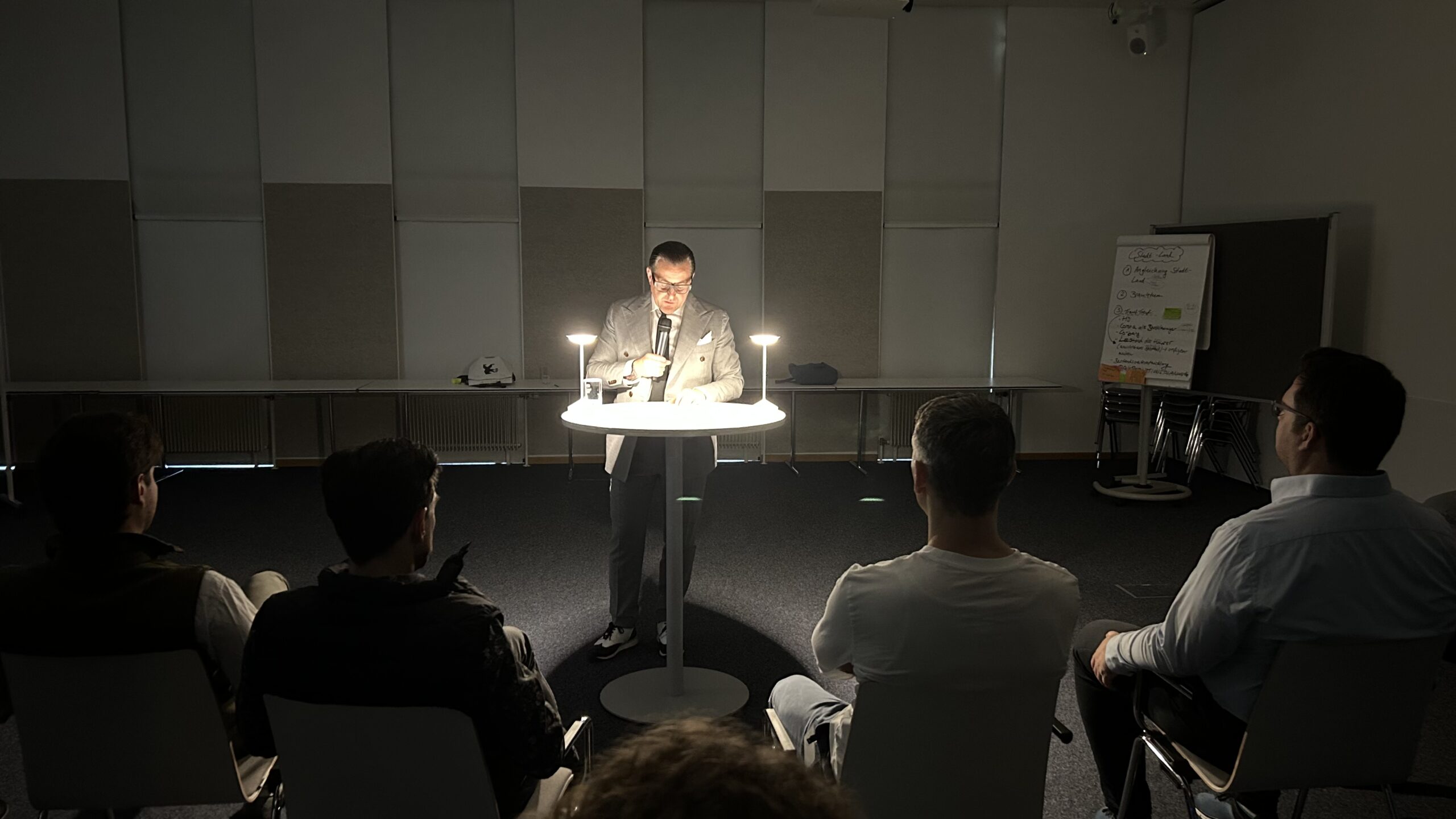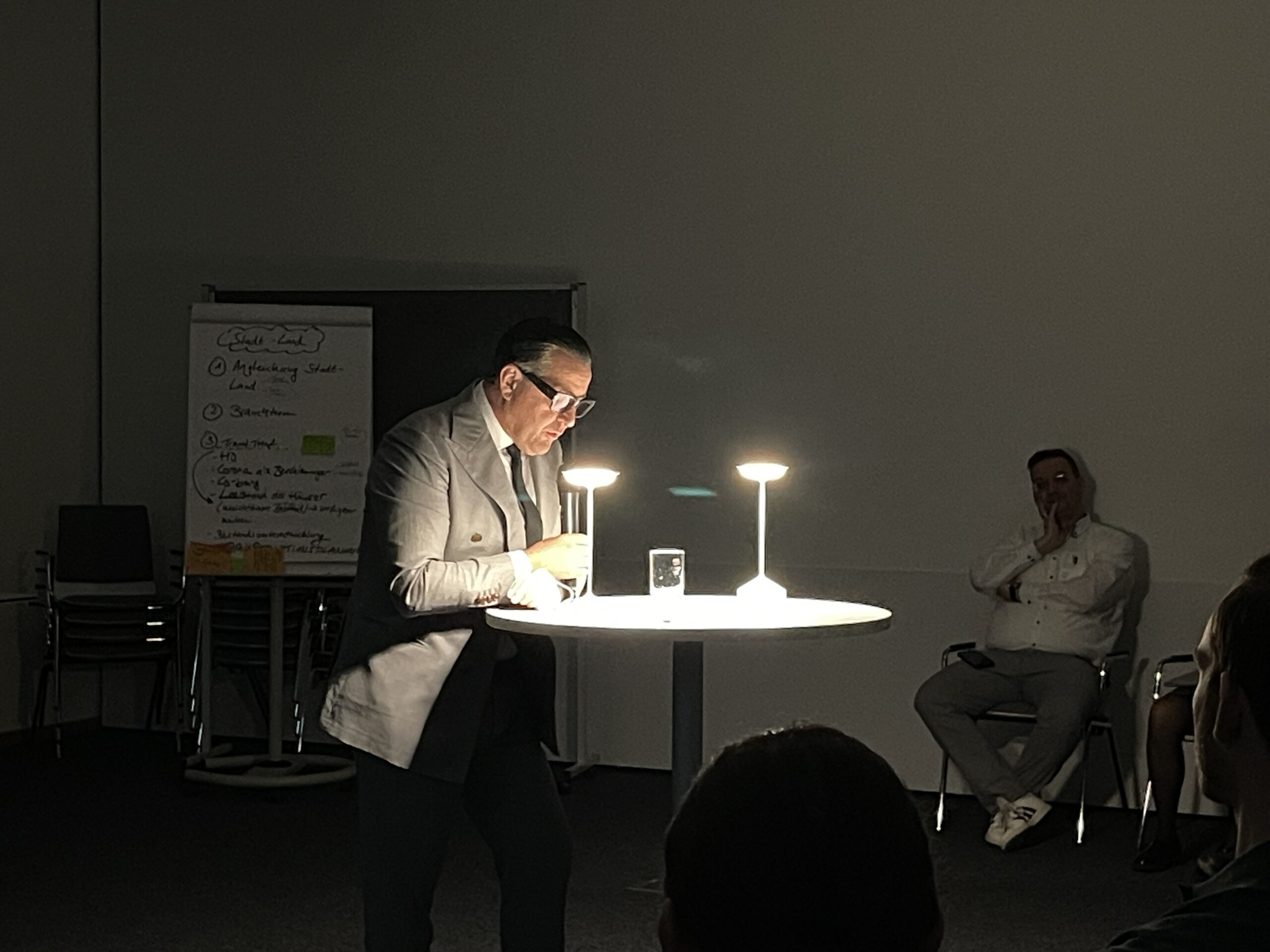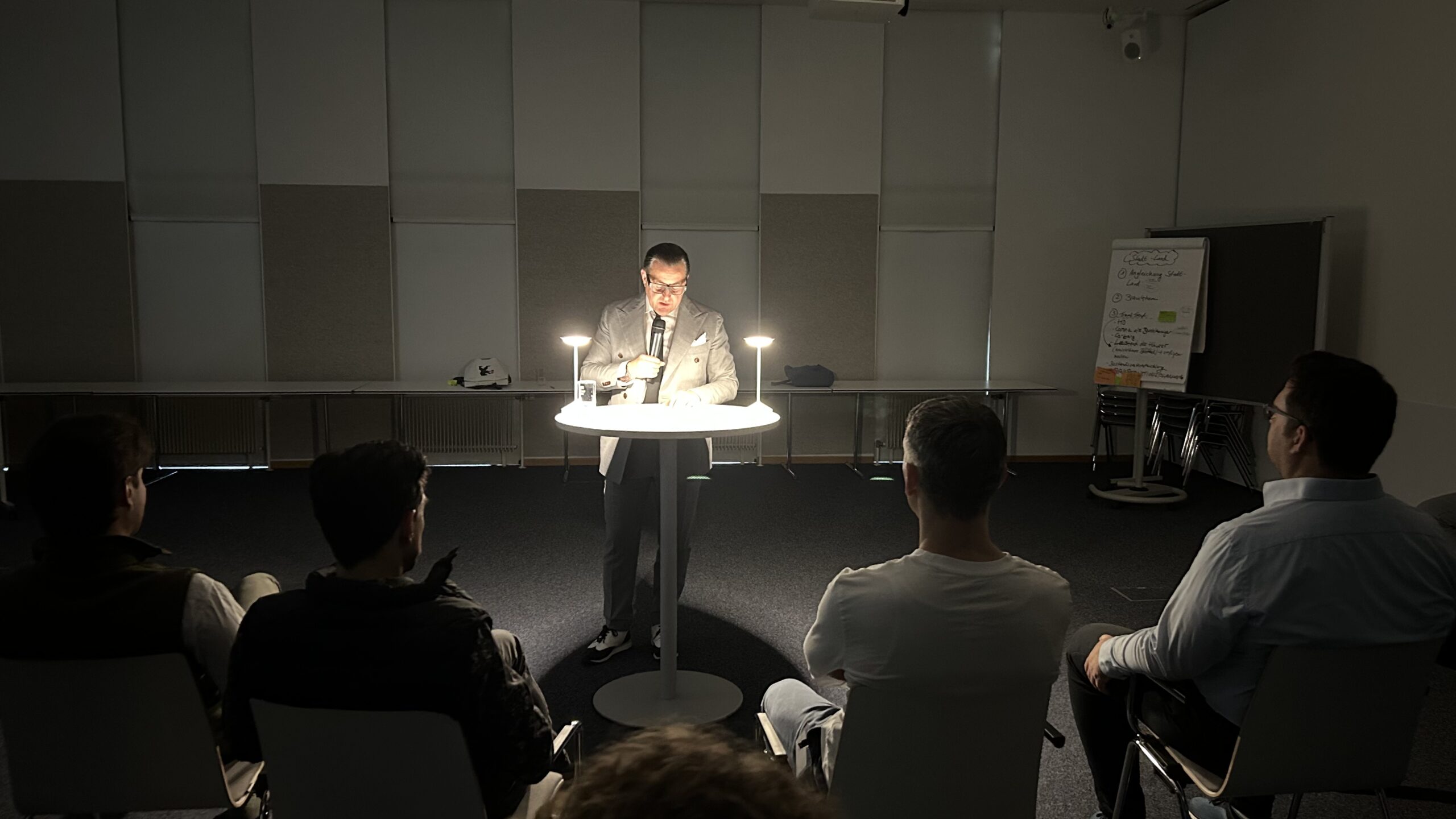
25 Jan Ramp darkness.
Megatrends and counter-trends were the topics at Salzburg AG, hosted by MOONCITY and Porsche Holding.
On April 2 and 3, 2025, the topic was “SO GEHT ZUKUNFT!” and transformative trends. An interactive exchange of experiences between around 60 people (corporate innovation managers from various industries) at various locations in Salzburg.
SO GEHT ZUKUNFT 2025 – inno.x.network
Nothing spreads as much darkness as the searchlights of this world.
What their beam does not hit, they plunge into dark insignificance. We see this and that in the spotlight, not this and that in the dark. This applies to stars and starlets here on earth as well as to the celestial bodies high in the firmament. Darkness cannot be seen. It is. On the other hand, we see and follow the stars, even though they have not existed for millions of years. A planetary-paradox phantom pain as a symbol and compass for society and industry.
Like the first factory ships of the whalers, we have always navigated with an extinct star, cruising the oceans of opportunity to hunt trends like whales, harpoon them to cannibalize them on board, cut them into commercially juicy fillets, label them beautifully, advertise them nutritionally, boil the oil to supposedly brighten the world and carve new followers from the carcass.
While this industrially productive slaughter takes place on board, trend scouts sit high above the bloody deck in the crow’s nest – ready to look out. Ready for the highly visible groups of whales, also known as schools, which usually consist of 10 to 50 animals, but on certain occasions can number well over 1000. Socializing with other whale species is also possible, trend and trend like to join forces.
Supposedly easy, superficial prey on the horizon, full trend barrels in the hold. Set sail, searchlights on, now more than ever follow the fleet and not the deviation, the digression, the turn, the deviance. To the oars, into the fishing boats. Focus! Efficiency. The harpoons are sharpened for profit. Sharpened for the marshes. All teams are ready for the golden doubloon on the main mast.
Then the seagulls laugh and a ghost from the deep suddenly attacks. The blow, a fountain of mist made of expelled whale air, can be heard.
The warning cry “Counter-trend, counter-trend – there it blows!” finally rings out from full throats. Too late. The ship’s owners, including the men and women on board, only had the upward, downward, horizontal, short-term, long-term and seasonal trends in mind.
But now it is clear to everyone: this scarred and bent humpback from the lee of history is not a snow mountain, it is the white whale Moby Dick. He will not flee, he is coming at us in a rage to ram us with all his might, to take revenge and drag our distribution system, with all its hopes and failures, to its doom.
And only one will survive, as prophesied by the mad Elijah.
Ladies and gentlemen,
Hermann Melville’s great novel Moby Dick is intended as a portent, as the swan song of a sinking and brutal industry, through which America was enlightened but disruption was to be found in the shadows. A metaphor for the complete exhaustion of a trend and the refusal to acknowledge a force of change from an unknowable depth.
The hunt for the white whale is therefore not just the battle of a captain named Ahab against a leviathan, against evil and against fate. It is also about human greed for profit, excessive capitalism, the plundering of natural resources and our supposed lack of alternatives to so-called megatrends.
Ws with the question that always implies the singular. What is the meaning of life?
As a pluralistic counter-trend, the idea that there are senses of life should prevail.
In any case, megatrends lead us into a strait and not out onto the seemingly endless ocean. Megatrends will leave us stranded at some point, driving us into the digital dragnets of the MS “Fourth Industrial Revolution”.
We are becoming increasingly entangled in absolute dependence on Broligacher technologies and their political will. Musk, Musk – there he blows!
It is a technological revolution coupled with a political coup that is fundamentally changing the way we live, work and interact with each other. In its scale, scope and complexity, this transformation will be an unprecedented experience.
We don’t yet know exactly how it will unfold, but one thing is clear: the response is all-encompassing and concerted, involving all stakeholders in the global community, from the public and private sectors to academia and civil society.
Because, as we are realizing better every day, there is a connection between the technological upheavals, the economic and financial crises, the rise of populism, the retreat of democracy and the onslaught of misanthropes.
The fact is that the companies from the various tech valleys are already more powerful than the Roman and Mongolian empires combined. The contours of this empire are virtual, but its power is real. They rule a nation that currently numbers 5.5 billion people and is constantly growing. They are already in control of the interpretation of their truth. They are already creating alternative realities.
Between 2000 and 2022, global internet usage increased by 1,355 percent.
While the global data volume in 2017 was still 26 zettabytes, five years later it was already 104 ZB. One zettabyte is one billion terabytes.
According to an estimate by the International Data Corporation, the volume of digital data will increase to 284 zettabytes by 2027.
The harpoons are sharpened for profit. Sharpened for the marshes. All teams are ready for the golden doubloon on the main mast!
Humanity’s answer is the question. That is why I am asking us about the following trends:
What if history knows no end, only beginnings and transformation?
How will humanity prove itself on the eve of transhumanism?
How will global society develop just beyond the present if we turn to a monotheistic technology such as artificial intelligence?
What if we turn technology into theology, like wine into water?
And trinity to digitality?
How will we act when the Internet no longer connects the world but reveals new demarcation lines and sets us new boundaries?
Ladies and gentlemen,
are we listening live to the swan song of the old, the paean of the new, the singing of the sirens? Are 75 years of human rights and conventions enough?
Does Immanuel Kant’s philosophical draft On Perpetual Peace now only serve as yesterday’s newsprint in which to wrap today’s fishing?
Gottfried Wilhelm Leibniz climbs onto the temple roof for us and looks into time: “The present is pregnant with what is to come; the future could be read in the past; what is far away is expressed in what is near.”
And infrastructures and networks, machines, sensors and artificial intelligence now seem to be close, very close, to breaking the dominance of humans. Robots no longer just want to robotize, no longer just want to work, they want to learn! They could take away our thinking, our creativity, our muse and our freedom.
So is the singularity beckoning like the dead Captain Ahab, tied to the white whale, to lure us into the depths?
The singularity, i.e. the point in time when artificial intelligence surpasses human intelligence, thereby rapidly improving itself, irreversibly accelerating technological progress and making the future of humanity predictable. Is it beckoning?
Is there still a balance between horror and potential?
Is technology a self-curse?
In any case, the machines have not sworn the assertoric oath of truth or the promissory oath of allegiance to us. So if the technology turns against humanity, we will not be able to prosecute them.
Ladies and gentlemen,
there are currently diametrically opposed trends that we associate with all-encompassing mechanization.
The former, the euphoric vision, is mainly spread by US companies and promises a future in which all we have to do is sit back and let intelligent systems decide for us. On the other hand, the apocalyptic vision conjures up a digital dictatorship in which people lose all privacy and self-determination under the control of corporations and computers and machines assume omnipotence.
What both views have in common is the passivity of man and the feeling of being at the mercy of fate with promises and threats.
Ladies and gentlemen,
yes, the turnaround in the world should worry us. Wars, the climate crisis, hunger, religious extremism, terrorism, massive global migration and crises of confidence are causing us to struggle in an overheated, nervous and reeling society. Polycrises and conspiracy narratives as well as digital despots are gnawing away at both the foundations of our state buildings and our mental health.
Ladies and gentlemen, congratulations, today is April 3, International Ass Card Day.
The choice of this date as Arse Card Day refers to the Bundesliga match of the 27th matchday between Eintracht Frankfurt and Eintracht Braunschweig on April 3, 1971.
In the 20th minute of the match, which Frankfurt won 5:2 in the end, Bochum referee Wilfried Hilker showed Frankfurt player Friedel Lutz the red card after a revenge foul against Braunschweig’s Jaro Deppe.
This was the first red card in the Bundesliga, and for a long time it was claimed that the cards were mainly in the referee’s pockets for the black-and-white TV viewers.
Without this division, they would otherwise not have been able to recognize the differences in colour between yellow and red cards. Anyone who got a red card in black and white at that time was screwed. Analytically, it therefore seems important to be in the right place at the right time and to take action in a new order.
But how to find them? And how to act there? In any case, a megatrend road map that can be conveniently downloaded with a click will not lead us to Eldorado, because as Hermann Melville notes in white “They are not on any map. The real places never are.”
But where seagulls fly excitedly, laughing and screeching far out at sea, large circles form on the surface of the water beneath them.
Where there are seagulls, there will be Moby Dick. Where there are whales, seagulls will land. They smell land where there is no land yet.
Professionally, dear audience, I am reviving so-called brownfields, i.e. derelict production sites that have also seen the social red card, but are now bucking the trend and turning into color fields. Such as the Tabakfabrik in Linz, the Otto Wagner Areal in Vienna or the Horizont in Steyr.
Special circumstances require incomparable spaces. Real and effective places. Counter-positions, abutments to the everyday world. Utopias that are actually realized, in which the existing places within culture are simultaneously represented, contested and turned around. Places outside of all places, so to speak.
Spaces and places that trigger phenomena through the superimposition of strict, regular structures and actions. Magical moiré effects that reveal something new in the blur. Phenomena that are able to temporarily evoke a hybrid WE, like a modern morgana, flickering and flickering between the individual and the collective.
Michel Foucault, the influential French philosopher, historian, sociologist and thinker of the 20th century, would probably classify these places as heterotopias. Places between trend and counter-trend. Spaces in the midst of transformation.
Gathered here today,
the realization of a sustainable place, a ‘protopia’ that differs from the idealistic utopian and the desperately dystopian through its proactive orientation that leads to action is an important titanic task for us all.
We don’t need a new mind, we need a new set.
A counter-trend to a fragmented society and the isolated individual. Digitalization in particular is also leading to a renaissance of spatiality. The physical and the psychological. The rebirth of the haptic, of understanding through comprehension, the revaluation of symbols, the importance of free speech and intensive listening, the enjoyment of exclusivity and devotion to rituals.
Dear colleagues,
utopian thinking has often been buried. The obituaries have always been premature. As long as there are people who believe that a society without violence, injustice, labor and the destruction of nature is possible and who are outraged by the discrepancy between the real and the possible, they will continue to dream up utopias.
Watch out for the seagulls and smell land where there is no land yet!