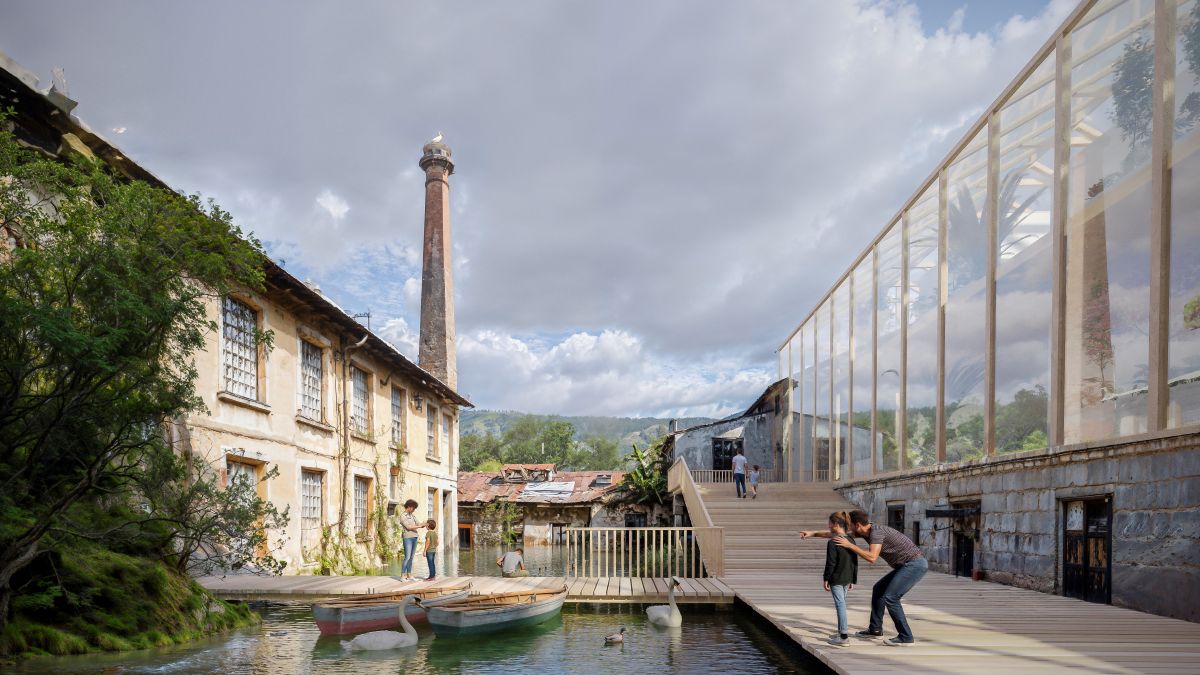
In the mystical north of Lower Austria, sung by the wind, surrounded by the mists of the Waldviertel, oppressed by progress and marked by dam breaches, Johann Anderl’s factory is bogged down. A temple of disruption and a cathedral of machines surrounded by thorns and legends.
A former textile factory and life’s work hanging by a thread, a place on a roll, a place in the mire of time. Buildings as dull reflections of lost industries, damp walls as idols of decay, an ensemble as phantom pain. Formerly manufacturing land as the level of society!
Together with our colleagues at Tp3 Architekten, we are rethinking the estate for our client. We want to build another country, survey a new one! Save the inevitable demise through flooding. Give the area a century through flooding.
Newly created footbridges, bridges, transitions, spaces and floating pontoons serve as life rafts, safe paths, workshops and labyrinths from which one can escape. Mirror images on the surface of the water act as a reflection of one’s own actions and help to evoke positive, shimmering insights.
Another country as a metaphor with highs and lows. Shadows and light.
Another country built from water, symbols, history and humanity.
Another country made of boats and lifebuoys, art and culture.
The ANDERLand as a place outside of all places.
The ANDERLand as a safe coast in the storms of the soul – with a factory chimney visible from afar, which announces the mission of the clients like a warning finger pointing and acts as a lighthouse for the hopeless.
ANDERLand as a possible venue for the Lower Austrian provincial exhibition “Wasserwelt Waldviertel” 2028.
The ANDERLand as an attraction and gateway for the “Wetland City” initiative of the municipality of Schrems in line with the international convention on wetland protection. Schrems wants to become Austria’s first “Wetland City” under the international Ramsar Convention for the protection of wetlands. The aim is to preserve and sustainably use the ecologically valuable moor and water landscapes around the town. The initiative strengthens environmental education, soft tourism and regional identity.